Showing posts with label screw the middle class. Show all posts

Tuesday, June 14, 2011

VIDEO: GOP Candidates Call For Massive Deregulation, Dismantling Of Health, Worker and Consumer Protections


Last night, seven of the Republican 2012 presidential hopefuls participated in a debate in New Hampshire, and as the Wall Street Journal noted, the candidates used the occasion to “[press] for the dismantling of government regulations drawn up over 40 years.” Indeed, the candidates unveiled a deregulatory zeal, proposing to repeal everything from environmental and labor protections to the Dodd-Frank financial reform law and regulations included in the Affordable Care Act. Here are some highlights:


NEWT GINGRICH: The Congress this year, this week, ought to repeal the Dodd-Frank bill, they ought to repeal the Sarbanes-Oxley bill.


REP. MICHELE BACHMANN (R-MN): What we need to do is pass the mother of all repeal bills…and I would begin with the EPA, because there is no other agency like the EPA. It should really be called the job-killing organization of America.


RICK SANTORUM: This president has put a stop sign against oil drilling, against any kind of exploration offshore or in Alaska and that is depressing. We need to drill.


GINGRICH: And one of the things Congress should do immediately is defund the National Labor Relations Board.


HERMAN CAIN: If the federal government continues to do the kind of things that this administration is trying to do through the backdoor, through the National Labor Relations Board, that’s killing our free-market system.


Watch a compilation:


Despite a financial crisis caused in large part by deregulation, climate change wreaking havoc on the country, and plummeting unionization coupled with plummeting incomes, the GOP still seems to believe that the government has no role in setting rules of the road or enforcing any sort of standard to guard against corporate greed or environmental devastation. Former Massachusetts Gov. Mitt Romney (R) even seemed to imply that the government should privatize disaster relief, responding to a question about FEMA by saying, “Every time you have an occasion to take something from the federal government and send it back to the states, that’s the right direction. And if you can go even further and send it back to the private sector, that’s even better.”


But not every statement uttered by the candidates was anti-regulation. Cain replied to a question about whether the government has a role in food safety by saying, “The federal government should be doing food safety, yes.”

Wednesday, April 20, 2011

Headed off the cliff


"I think the hardship is negligible." —State Rep. David Agema, supporting cutting out the clothing allowance for poor children without parents


"Let 'em eat cake." —Marie Antoinette


Yes, there is a difference between those two statements. Poor, eventually headless Marie never said any such thing. But David Agema, arguably the worst member of the Legislature, did indeed say that, and worse, last week.


Agema is a narrow, far right-wing Republican, a former airline pilot from Grand Rapids. Until last week, his major claim to political fame was this: Back during the battle to balance the budget in 2007, the year there was a brief government shutdown, he was the only member of the Michigan Legislature not to show up.


Why? Well, he was off hunting sheep in Siberia, which he deemed more important. Two years later, an EPIC-MRA survey of political insiders found he was the least effective legislator.


Unfortunately, he has power now; he chairs a subcommittee overseeing the Department of Human Services budget. Agema defended cutting $9.9 million from the clothing allowance for orphans, saying he thought the money often was used for other things. Perhaps he worried they used it for contraband, like food.


The Michigan Catholic Conference was aghast, saying this "would only create greater hardships for the poor and disadvantaged children and disabled persons across the state."


Disabled? By the way, Captain Crunch also cast the deciding vote cutting State Disability Assistance for people who have gallantly struggled to live independently. They had been getting $269 a month. That's being slashed to $175.


That one, by the way, was Gov. Rick Snyder's idea. Agema, who cast the deciding vote to kick the disabled, gallantly defended it, however, with the most powerful intellectual argument his airline pilot brain could make: They don't give them any money in Indiana.


Agema is a special case of callousness, but not that special. Throughout the capitol, committees and subcommittees are weakening the things that make civilization possible. Slashing education, endangering children and the poor, toppling the former middle class into poverty.


Some of this is being done because post-automotive Michigan has little money, and we've been covering up deficits and running on fumes. But mostly, what they are doing is designed to give huge tax breaks to business.


The theory has become an article of mindless right-wing faith. Slash taxes; businesses pour in and create vast amount of new jobs.


Even at a lower rate of taxes, money comes pouring in to state coffers, and Lansing can fund education again. Maybe even buy a pony. Only trouble is that it doesn't really work very well, if at all.


They don't call it the Laffer Curve for nothing.


Kyle Melinn, editor of the respected MIRS newsletter, which covers Lansing, wrote an interesting piece last week revealing that nobody has any idea whether slashing taxes Snyder-style would create any jobs at all. He noted that Snyder and Lieutenant Gov. Brian Calley have been pulling back from their earlier confident pie-in-the-sky predictions of jobs galore.


Last week, after touting his plan, the governor added, "I can't guarantee results." His deputy echoed that, saying, "What we do believe is that our plan will create an environment that is likely to encourage job growth."


What nobody talks about is studies that show modern businesses care more about quality of life than taxes. Melinn posed the key question our lawmakers are failing to ask: "Is this 'economic gardening' going to coax business leaders into our state — or will the business community's argument about needing a tiny tax rate be exposed as humbug when private-sector decision-makers recoil at our crummy roads, disinvested schools, depleted police forces and sky-high university tuition rates?"


The governor is betting everything on this one tremendous gamble. Those who don't like it have little choice.


The Democrats haven't even offered any alternative plan. That's because they are afraid to say what they need to say, which is that it is time for the rich to pay their fair share.


That's right. For the last 30 years, we've been engaged in a giant transfer of wealth in this country from the poor and the middle class to the wealthiest 1 percent of Americans.


That, more than anything else, is destroying this country, aided by the nastiness and anger and silly ideological polarization.


Charley Ballard, a Michigan State professor who knows more about this state's economy than anyone, tells me we could increase our income tax rate from 4.35 percent to 5.5 percent with virtually no negative effects — and vast positive ones.


We could use that money to repair some of our crumbling infrastructure and invest in early childhood development, things business should want, Ballard told me.


Tragically, you don't hear Democrats talking about this, because they have no guts. The best, as Billy Butler Yeats used to say, lack all conviction. The worst are filled with passionate intensity. ... As the lemmings used to say, see you at the cliff.


Thursday, April 14, 2011

Amash, Benishek, Walberg and Michigan Republicans Pushing Extreme Budget Proposal


by John Tramontana


Some Michigan Congressional Republicans are proposing a budget much more extreme than Congressman Paul Ryan’s proposal that was announced last week. The Republican Study Committee (RSC) plans to cut $9.1 trillion from the budget – attacking Medicare, Medicaid, Social Security, and children’s nutrition programs.


Congressmen Justin Amash, Dan Benishek, Dave Camp, Bill Huizenga, and Tim Walberg are members of the RSC.


According to The Hill, the plan would raise the age of Social Security eligibility to age 70, privatize Medicare, reduce Supplemental Security Income, and reduce child nutrition spending.


“These are programs that are keeping many of our seniors, kids, and low-wage workers above the poverty line,” Michigan Democratic Party Chair Mark Brewer said. “These GOP Members of Congress would rather give tax breaks to oil companies, drug companies, insurance companies, big banks, and the wealthiest 1% of the population and force our kids, seniors, and low-wage workers to pay for it. That’s wrong.”


Wednesday, April 6, 2011

Paul Ryan’s Multiple Unicorns

By Paul Krugman


Gosh. For a plan that supposedly sets a new standard of seriousness, Paul Ryan’s vision (pdf) depends an awful lot on unicorn sightings — belief in the impossible. Let me review the top three unicorns.

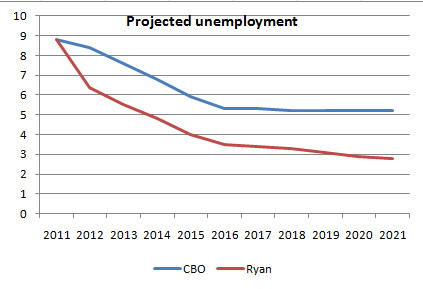
First, the plan assumes that tax cuts will set off a literally unprecedented boom. Here’s again, is what is assumed about unemployment:

DESCRIPTIONHouse budget proposal

So Ryan is claiming that unemployment will plunge right away; that by 2015 it will be down to the levels at the peak of the 1990s boom (and far below anything achieved under the sainted Ronald Reagan); and that by 2021 it will be below 3 percent, a level we haven’t seen in more than half a century. Right.

Then there’s the Medicare business. According to the CBO analysis, a typical senior would end up spending more than twice as much of his or her own income on health care as under current law. As Dean Baker points out, this means that seniors would end up paying most of their income for health care. Again, right.

But in a way, the worst part isn’t the Medicare plan: it’s the fact — which so far has not penetrated the debate — that the biggest source of supposed savings in the plan isn’t actually health care, it’s an assumption that federal spending on everything except health and Social Security can somehow be squeezed, as a percent of GDP, to a small fraction of current levels. Here’s the table, from Ryan’s own report:

DESCRIPTION

Notice the marked area at the bottom: Ryan is assuming that everything aside from health and SS can be squeezed from 12 percent of GDP now to 3 1/2 percent of GDP. That’s bigger than the assumed cut in health care spending relative to baseline; it accounts for all of the projected deficit reduction, since the alleged health savings are all used to finance tax cuts. And how is this supposed to be accomplished? Not explained.

This isn’t a serious proposal; it’s a strange combination of cruelty and insanely wishful thinking.

Monday, March 21, 2011

CHART: Taxing Millionaires Would Save Billions More Than Cutting Education And Programs For Main Street

By Zaid Jilan


All around the country, right-wing legislators are asking Main Street Americans to pay for budget deficits caused mainly by a recession caused by Wall Street by attacking collective bargaining, and cutting necessary services and investments like college tuition aid and health care for the poor.

As these conservatives are cutting these services for hard-working middle class Americans, they are claiming they are acting out of need for “shared sacrifice.” Yet at the same time, the right continues to advocate for massive tax cuts for the wealthiest among us.

Rep. Jan Schakowksy (D-IL), along with a number of her progressive congressional colleagues, has introduced a plan that demands real “shared sacrifice.” Her plan, The Fairness in Taxation Act, calls for creating new tax brackets for the richest Americans, starting at a 45 percent rate for people whose income is $1 million. Her bracket would impose the highest rate — 49 percent — on billionaires.

A chart provided by her congressional office demonstrates that asking the wealthiest among us to pay a little more would actually save more money than all of the House Republicans’ cuts to domestic spending combined. House Resolution 1, which gutted funding on Pell Grants, low-income housing aid, community health centers, and other important programs for Main Street Americans, cut a total of $61 billion. Meanwhile, Schakowsky’s plan saves $78.9 billion, considerably more:

In an interview with ThinkProgress, Schakowsky said that she is “hoping” to build enough momentum within Congress to make her proposal the main alternative to the conservative slash-and-burn budget effort, saying that it is a “winner” for Democrats, both politically and on policy grounds. She said that the House Progressive Caucus is planning to do a road show in the summer to campaign on tax justice and endorsed the Main Street Movement that is defending the middle class across America:

THINKPROGRESS: You’ve mentioned a few times the grassroots movement that’s going on…that’s something that we here at ThinkProgress have dubbed the Main Street Movement, all around this country we’re seeing working families rise up. [...] I wonder if you’ve and your colleagues on the Progressive Caucus have thought about similar kinds of tactics [to the Tea Party], a road show, holding rallies, trying to engender grassroots momentum around your proposals.

SCHAKOWSKY: Well, the Progressive Caucus is planning a road show this summer. This will be a central theme of that. [...] But I think this needs to be bigger than that. [...] I like the idea of branding, I like the idea of the Main Street Movement, and I think it is beginning to seriously come together. I think all of the pieces are out there to put this together right now. This is a moment. I want to capture it right now by introducing this legislation that clearly states an alternative that is very popular.

Listen to it:

Indeed, taxing the super-wealthy is quite popular. A March 2 NBC News/Wall Street Journal poll found that 81 percent of Americans prefer taxing the wealthiest Americans more as their top choice for deficit reduction, while less than a third of Americans endorsed policy options like cutting funding to education and health care.

UPDATEThinkProgress commenter Jay Kimball used IRS data to put together thefollowing graph showing how the richest 1 percent of Americans is nearly earning more money than they ever have while they are paying the lowest taxes in decades: